
Modern QA Dashboard in the AI Development Era
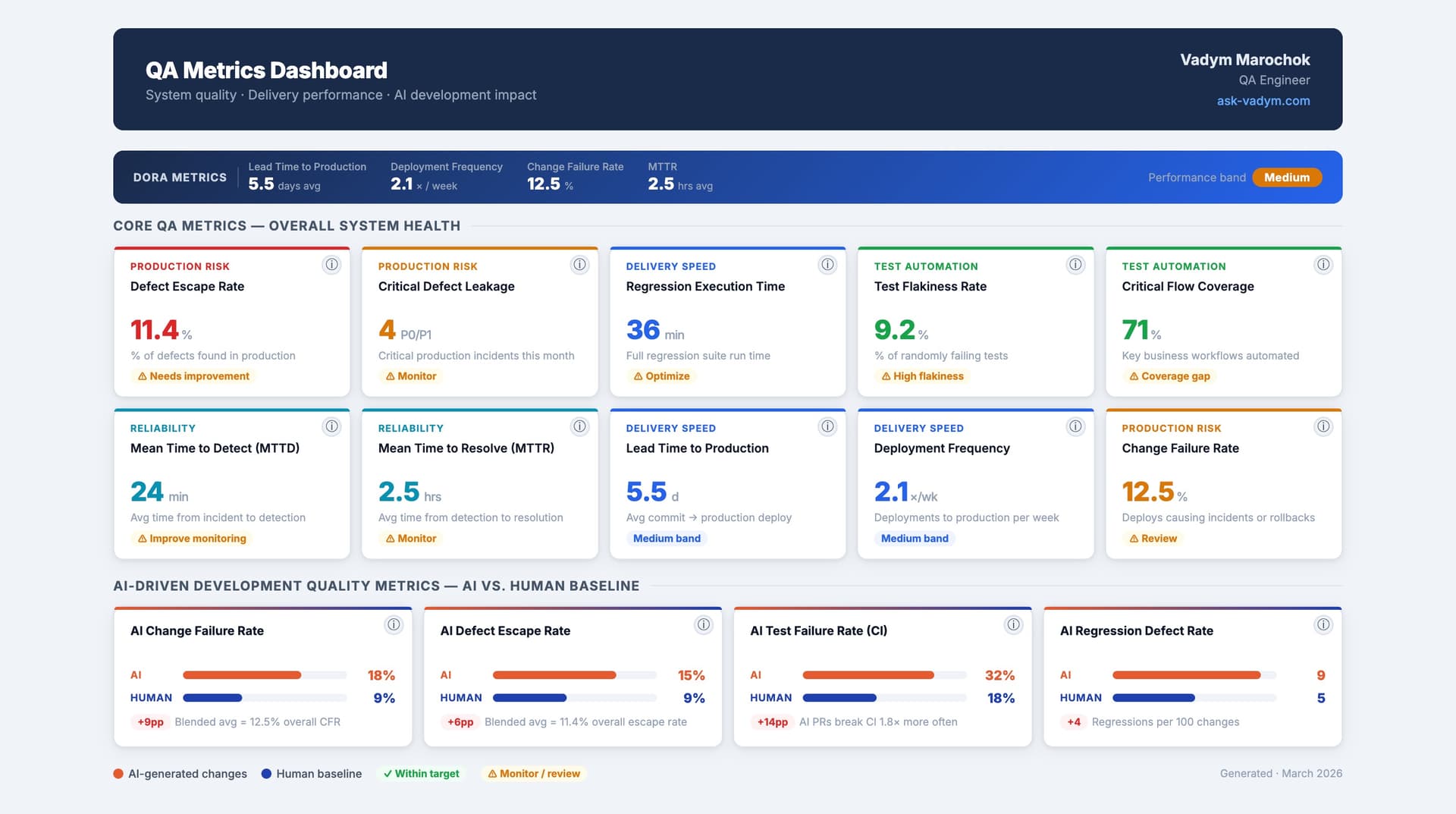
Software delivery has changed dramatically in the last few years. Teams are shipping faster than ever, often with the help of AI assistants or even autonomous agents generating code. But one thing hasn't changed:
Quality is still the bottleneck.
The faster you ship, the easier it is to break things in production.
That's why modern QA is no longer about counting test cases or pass rates. It's about understanding the balance between:
Speed vs Risk
In this article, I'll show how a modern QA dashboard can look today, combining classic engineering metrics with a new AI-aware layer.
Working example
View live QA Metrics DashboardWhy Traditional QA Metrics Are Not Enough
Many teams still rely on metrics like:
- number of test cases
- pass/fail rate
- code coverage
These don't reflect real product quality anymore.
Modern teams need metrics that answer:
- Are we breaking production?
- How fast do we deliver safely?
- Can we trust our automation?
- How quickly do we recover from failures?
And now, additionally:
- Does AI-generated code introduce more risk?
The Structure of a Modern QA Dashboard
A good dashboard today is built in two layers:
- Core QA Metrics (overall system health)
- AI vs Human Quality Metrics (impact of AI-generated changes)
This separation is important.
You don't want an "AI hype dashboard".
You want a quality dashboard that remains valid even without AI.
Layer 1: Core QA Metrics (System Health)
These metrics measure the overall quality of your system, regardless of how code was written.
Production Risk
- Defect Escape Rate — How many bugs reach production. The most direct signal of QA effectiveness.
- Critical Defect Leakage — Number of P0/P1 incidents. This is what the business actually feels.
- Change Failure Rate — How often deployments cause incidents or rollbacks. A key DORA metric.
Delivery Speed
- Lead Time to Production — How fast changes go from commit to production.
- Deployment Frequency — How often you release.
- Regression Execution Time — How quickly QA can validate a release.
Test Automation Health
- Test Flakiness Rate — How reliable your test suite is.
- Critical Flow Coverage — How well key business flows are protected.
Reliability & Operations
- Mean Time to Detect (MTTD) — How quickly you notice production issues.
- Mean Time to Resolve (MTTR) — How quickly you fix them.
Together, these metrics describe the full lifecycle of quality:
Build → Test → Release → Monitor → Recover
Layer 2: AI vs Human Quality Metrics
This is where things get interesting.
Instead of trying to measure "AI code quality" in isolation (which is unreliable), we compare:
AI-generated changes vs Human-generated changes
This gives real, actionable insights.
- AI Change Failure Rate — Do AI-generated deployments fail more often?
- AI Defect Escape Rate — Do AI changes leak more bugs to production?
- AI Test Failure Rate — Do AI pull requests break CI more often?
- AI Regression Defect Rate — Do AI changes break existing functionality more frequently?
These metrics don't try to guess "who wrote the code". They measure what happens after the code is shipped.
What Makes This Dashboard Modern
This approach reflects how engineering actually works today:
- AI increases development speed
- Risk shifts to production
- QA becomes a system-level responsibility
Instead of focusing on: "Did we test everything?"
We focus on: "Are we shipping fast without increasing risk?"
A Practical Insight
One of the most useful patterns in the dashboard is comparison. For example:
AI Change Failure Rate = 18%
Human Change Failure Rate = 9%
This immediately tells you:
AI-generated changes are currently 2× riskier
No speculation. No assumptions. Just data.
Final Thought
Modern QA is no longer about testing features in isolation.
It's about controlling the system:
- delivery speed
- production risk
- automation reliability
- incident recovery
- and now, AI-generated change quality
A good QA dashboard doesn't just report metrics.
It tells a story:
Are we moving faster without breaking things?
If the answer is yes — you're doing modern QA right.
See it in action
View live QA Metrics Dashboard